
A merger finalized after two years. Business grew tenfold. A friendship saved in five minutes.
These are results, not theories. Once you start, you can’t stop: Real stories of S.H.A.R.E.® Tools in action
I have been in enough boardrooms, turnaround situations, and high-stakes conversations to know this: people do not fail because they are not smart enough or talented enough. They fail because the conversations around them are broken.
Strategies stall when people are afraid to speak up. Deals fall apart when teams talk past each other. Relationships fracture when no one knows how to have the hard conversation that actually needs to happen. And opportunities—some of them life-changing—get buried because people are “keeping it safe.”
I developed the S.H.A.R.E.® Tools—Stop, Help, Ask, Risk, Explore—to address exactly this. Here is how each step works: Stop—pause the automatic response; Help—invite other perspectives or assistance; Ask—seek clarity through questions; Risk
—share honestly, even if it feels vulnerable; Explore—consider possibilities and next steps. This is the core engine inside Revolutionary Conversations®, and I have watched it transform situations that seemed completely stuck. Not in theory. In practice. In real businesses, real families, and real moments of conflict.
The World We Are All Operating In Right Now
Before I get to the examples, I want to acknowledge something. We are all being pulled in a thousand different directions right now—by technology, by economic pressure, by personal stress, by the constant noise of a world that never seems to slow down. For many of us, every day feels a little like a crisis management situation.
That is not a metaphor I use lightly. Crisis management is my work. And what I know from decades of it is this: in moments of high pressure, the instinct is always to move faster, react harder, and protect more tightly. But that instinct is almost always wrong. What the moment actually calls for is a breath, a pause, and a more deliberate way of connecting.
That is what S.H.A.R.E.® Lectures, Seminars and Workshops makes possible. And the stories below show you exactly how.
Example 1: The Merger That Finally Closed—and the Family That Found Its Way Back
A woman I know read the Revolutionary Conversations® book. She had been sitting on a business merger for almost two years. Not because the deal was bad. Not because the numbers did not work. But because she could not get herself—or the people around her—into the kind of clear, honest, forward-moving conversations the situation required.
Within two weeks of engaging with S.H.A.R.E.® Tools, she closed the merger.
Two years of stalled progress, resolved in two weeks. Let’s pause on that—it is easy to skip over. The deal and the other parties didn’t change. What changed was the quality of the conversations she was able to have—the listening, the asking, and honest risk-taking that came with them.
But that was just the beginning.
In that same two-week window, she reconnected with her mother, with whom she had been distant for a long time. She rebuilt her relationship with her stepdaughter—and I mean genuinely rebuilt it, to the point where they went from strained to what she
described as “best friends.” She also reconnected with her sister in a meaningful way.
“She keeps that book on her desk at all times.”
That detail matters to me. Not because I wrote the book, but because it tells you something about what happened. This was not a one-time fix. It became a way of operating—a daily reference for how to show up in conversations that felt stuck, scary, or important.
The business and personal outcomes were not separate events. They were the same event, driven by the same shift: learning how to stop, ask for Help, ask better questions, take the Risk of honesty, and explore what was actually possible.
Example 2: The Turnaround That Unlocked 10x Growth
My firm, Stowe Management Corporation, was brought in to help a struggling business. This was not a company in slow decline
—it was a situation that needed real intervention, real clarity, and real change. The kind of situation where the typical approach is to come in hard, restructure fast, and hope the numbers respond.
We did not do that.
Instead, we used S.H.A.R.E.® Lectures, Seminars and Workshops to shift conversations within the business—starting with the sales team. Now, many of the organizations I work with have a complicated relationship with their salespeople. Leadership thinks one thing; the sales floor knows another. There is usually a gap between what management believes is possible and what the people closest to the customers actually see every day.
By creating the conditions for Stop, Help, Ask, Risk, and Explore to happen—by making it genuinely safe for the sales team to share what they had been quietly sitting on—we uncovered something remarkable: a completely new pathway for growing the business that had been there all along.
“They’d been keeping it safe. Now they’re not hiding things. They’re putting things out there as they should.”
That phrase—“keeping it safe”—is one I hear over and over in turnaround situations. People have ideas. They have concerns. They know things that leadership does not. But they have learned—often from experience—that sharing those things carries risk. So they hold back. And the organization operates on a fraction of its actual intelligence.
S.H.A.R.E. creates an environment where people stop keeping it safe and start putting things on the table. The result in this case was a growth plan that projected the business would grow to ten times its current size within five years. Not from outside investment or a new product line. From the ideas and insights that were already in the room—just waiting for the right conversation to release them.
Example 3: Two Friends, a Political Divide, and Five Minutes
This one is my favorite, because it speaks to something beyond business.
In one of my classes, two people who had been good friends for years found themselves in serious conflict. They had navigated their political differences for a long time—they had, over the years, found a way to be close despite seeing the world very differently. But something shifted. Something happened. And suddenly they were at odds in a way that felt irreparable.
They asked me to use the S.H.A.R.E.® Tools with them.
Five minutes later, they were friends again.
I do not say that to make the process sound magical. It is not magic. It is structured. The five minutes worked because S.H.A.R.E. gave both of them a way to do what they had not been able to do on their own: Stop the reactive back-and-forth, ask for Help in understanding what the other person was actually experiencing, Ask the kind of questions that surface the real issue underneath the conflict, take the Risk of genuine honesty, and Explore what had actually happened between them.
By the end of those five minutes, each of them had said some version of: “Oh. I understand why you are experiencing this the way you are.” Their political views had not changed. Their values had not merged. But the emotional fog had cleared, and what was underneath it was a friendship that both of them valued far more than the argument.
“They began to realize—I understand why you’re doing this, why you’re experiencing this. And they went back to being friends again.”
This is what S.H.A.R.E. does. It does not erase differences. It creates a space where differences can be understood instead of just defended. And that is often all that is needed.
The Pattern Behind All Three Stories
Look at those three situations—a stalled business deal, a company in turnaround, a friendship in crisis. They are very different on the surface. But the underlying dynamic is the same in every one of them:
- People were rushing or stuck.
- People were protecting themselves instead of opening up.
- People were assuming instead of asking.
- People were holding back the ideas and honesty that the situation actually needed.
S.H.A.R.E.® Tools counter each of those tendencies systematically: Stop means to slow down and counter rushing; Help means to reach out, addressing isolation; Ask involves questioning, to counter assumptions; Risk asks us to be vulnerable and overcome self-protection; Explore encourages openness, addressing rigidity.
And once you start using it, something happens that I find genuinely remarkable: it compounds. The first conversation where you use it builds trust. That trust makes the next conversation easier. And slowly, the culture around you—in your business, your team, your family—starts to shift. People stop keeping it safe. They start putting things on the table. And that is where growth lives.
Start Your Own Story
 You do not need a merger on the table or a business in crisis to begin. Here is how to start in your very next conversation:
- When something feels stuck or confusing, say out loud: “Let’s slow down for a second.” That is your Stop.
- When you are in a meeting, try: “I’d like your perspective on this before we decide.” That is your Help.
- Replace your next statement with a question. That is your Ask.
- Share one idea that is not fully formed yet. That is your Risk.
- Before the conversation ends, ask: “What is one thing we can actually do with what we just discussed?” That is your Explore.
Five steps. Any conversation. Any situation. I have seen S.H.A.R.E. work in a quick hallway exchange and across a two-day strategy retreat. It works if you use it.
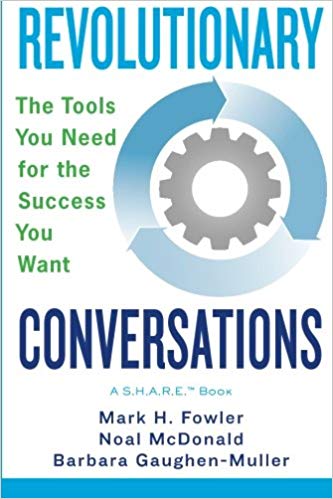
To go deeper, pick up the book—Revolutionary Conversations®: The Tools You Need for the Success You Want—on Amazon. Or reach out to us at Stowe Management Corporation to discuss what it would take to bring these tools into your organization.
Because here is the thing I want to leave you with:
Once you start, you really cannot stop. Not because the process is addictive, but because it works. Every time you use it, the conversations around you get better. The opportunities that were buried start to surface. The relationships that were fraying start to hold.
That is not a theory. That is what I have watched happen, again and again, for people who were willing to stop, ask for Help, ask better questions, take a Risk, and explore what was actually possible.
S.H.A.R.E.® Lectures, Seminars and Workshops Re-Engineer Your Business From the Inside Out
Your story is next.
 We are thrilled to welcome the President and CEO of Stowe Management Corporation, whose work is transforming the way businesses and people communicate. After decades inside struggling companies, failed mergers, and high-stakes turnarounds, our guest discovered that most business failures are really communication problems in disguise.
The result? The S.H.A.R.E.™ Method — Stop, Help, Ask, Risk, Explore — a practical, five-step framework that turns broken conversations into collaborative breakthroughs. Whether closing a two-year stalled merger in two weeks, unlocking tenfold business growth from ideas already in the room, or helping two friends reconcile in five minutes, the results speak for themselves.
In this conversation, you’ll hear a new way of looking at communication — not as a soft skill, but as the most powerful driver of value in your business and your life.

Subscribe to our Podcast!
Join our podcast live! Receive our Newsletter. Benefit from Mark H. Fowler’s progressive insights for your success, you can subscribe for free and receive Mark’s valuable experience in Business Consulting, Crisis Management, Managing Growth & Profitability, Mergers & Acquisitions, Succession Planning, Systems & Operational Analysis and more.
Over the years, I have worked with many good corporate citizens, who know that many lives depend on the way they do business. In the process, not only have these businesses and organizations been more successful, but we have all had fun along the way.” –Mark H. Fowler